
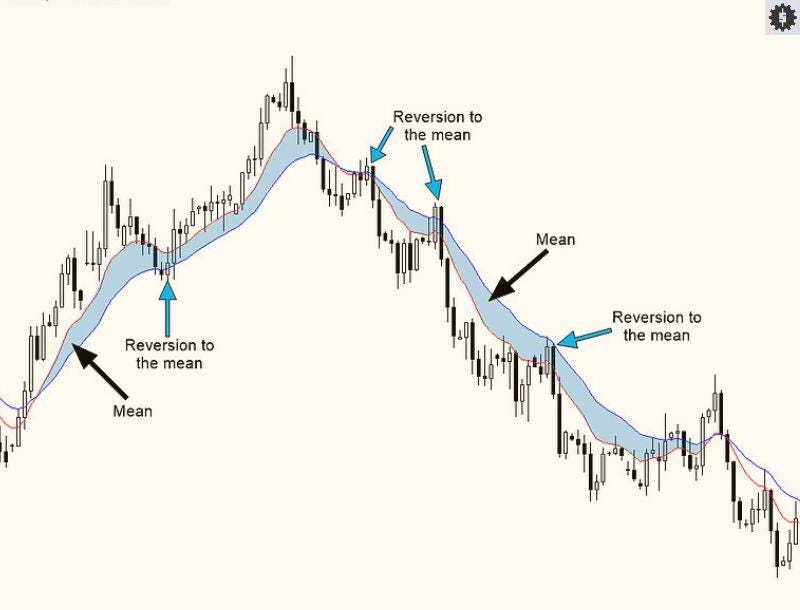
Mean reversion is a day trading concept based on a simple market tendency: after price moves too far too fast, it often returns toward an average. Traders use this idea to identify overextended moves, fade exhaustion, and aim for a move back toward a reference level such as VWAP, a moving average, or the session open.
What Is Mean Reversion?
Mean reversion is the tendency for price to move back toward its average after deviating significantly from it. In trading, the “mean” can be a simple moving average, exponential moving average, VWAP, or even an intraday equilibrium zone.
Markets rarely move in a perfectly straight line. Even in strong trends, short‑term pullbacks and snapbacks happen as traders take profits, momentum slows, or price reaches stretched conditions. That’s where mean reversion thinking becomes valuable.
Why Mean Reversion Matters in Day Trading
Day traders like mean reversion because it creates clear trade logic. Instead of chasing momentum, they look for moments when price appears extended and likely to revert toward value.
This strategy works best in range‑bound markets, choppy intraday conditions, and sessions with repeated swings around VWAP or the opening range. It is less effective during strong trend days, major news events, or highly directional market sessions where price can stay extended for longer than expected.
How Mean Reversion Works in Practice
A typical mean reversion trade follows a simple sequence: price moves far from its average, momentum weakens, a reversal or exhaustion signal appears, the trader enters in the opposite direction, and the target is a return to the mean.
For example, if a stock opens strong and rallies far above VWAP, a day trader may wait for a failed push higher, then short the reversal with VWAP as the target. The trade is not about predicting a crash, but about expecting a return to fair value.
Common Mean Reversion Setups
VWAP fade is one of the most common intraday setups. When price stretches too far above or below VWAP and begins to stall, traders may fade the move and target a return to VWAP or the session open.
Opening range reversion is another popular idea. If price makes a strong move out of the open and then fails to continue, it may drift back into the opening range or toward the open, creating a pullback opportunity.
Bollinger Band reversals help spot unusually stretched moves. When price closes outside the band and then re‑enters it, some traders treat that as a mean reversion signal, especially if the market structure supports it.
RSI‑based exhaustion setups are also widely used. Short‑term RSI can highlight overbought or oversold conditions, and traders often combine this with support, resistance, or VWAP for better confirmation.
Failed breakouts offer another fade‑the‑extreme scenario. When price briefly breaks a key level but cannot hold it, price often snaps back toward the prior range or mean, giving mean reversion traders a defined entry and invalidation point.
How to Trade Mean Reversion Safely
The biggest mistake is fading every extended move. Mean reversion works best when you first confirm that the market is not in a strong trend and that price is truly stretched.
A safer process is: identify the mean reference, wait for an extreme extension, look for loss of momentum or reversal confirmation, enter only after the market shows hesitation, place a stop beyond the extreme, and target the mean first. This reduces the chance of getting trapped in a breakout or trend continuation.
Best Indicators for Mean Reversion
VWAP is essential for intraday mean reversion, as it shows where the “fair value” line sits for the session. Moving averages provide a longer‑term reference for trend and average price.
Bollinger Bands help visualize volatility and overextension, while RSI highlights short‑term overbought or oversold readings. ATR can also be useful to understand how far price is likely to move in a session before reverting.
None of these indicators work in isolation. The best results come when price action, volume, and structure line up with the mean reversion signal.
Risk Management for Day Traders
Risk control is critical because mean reversion strategies can fail quickly when a trend accelerates. A good stop‑loss should sit at the point where the setup is invalidated, such as beyond the recent high or low that triggered the trade.
Always use defined risk on every trade, avoid fading major news releases, reduce size in trending sessions, and take profits near the mean or a nearby support/resistance zone. The goal is consistency, not catching exact tops and bottoms.
Example of a Mean Reversion Trade
Imagine a stock opens at 100, rallies quickly to 103, then stalls and forms a rejection candle. If VWAP is near 101.20, a trader might short the rejection and target the VWAP area.
In that case, the trader is not betting that the stock will collapse. The trader is betting that the price has stretched too far and is likely to revert toward its average. This kind of setup is typical in mean reversion day trading.
Mean Reversion vs Momentum Trading
Mean reversion and momentum trading are almost opposite approaches. Mean reversion trades assume that price will snap back to its average after an overextension, while momentum trading assumes that the current move will continue.
A good trader understands both and knows when to switch between them. Market context—such as whether the session is choppy or trending—often determines which style has the edge.




.png)